Productivity has been watered down.
It has been reduced to hacks, routines, and minimalist slogans that sound wise but quietly excuse mediocrity.
Somewhere along the line, we embraced a half-truth: “Just focus on one thing.”
As if human capacity were fragile.
As if responsibility were optional.
But true productivity isn’t about doing less or doing more.
True productivity is stewardship.
It is the discipline of honoring what you’ve been given — capacity, time, ability, opportunity — and refusing to bury potential under convenience.
Why True Productivity Is About Responsibility, Not Limitation
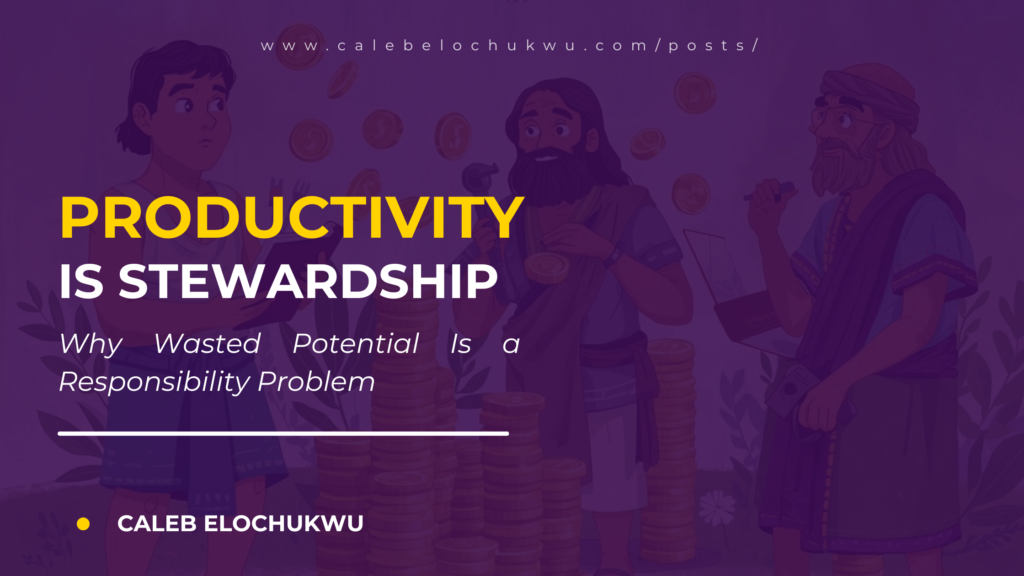
The Parable of the Talents (Matthew 25) teaches us that the essence of productivity is responsibility. It is not a story about ambition or competition. It is a story about stewardship.
In the parable, three servants are entrusted with different measures: five talents, two talents, and one. The distribution is unequal, intentional, and unapologetic.
We often attribute that to the “measure of abilities” of those who received the talents. But that is incomplete truth.
When the master returned, he did not judge them based on how much they were given. Neither did he sympathize with the one who had less.
The expectation was the same.
Utilize what you were entrusted with and produce results according to its measure.
The master never demanded more than was given.
But he absolutely demanded something be done with what was entrusted.
That is the heart of productivity.
Everyone Has Capacity—The Question Is Engagement
Every human being has been given gifts, talents, abilities, opportunities.
No one is empty.
Recognition is the starting point of a productive life—yes. But discovery alone is insufficient.
The real question is not what do you have? It is: what are you doing with it?
Are you developing what you’ve been given?
Are you deploying it?
Are you engaging it fully—or merely preserving it?
Two servants multiplied what they had.
One preserved what he had.
Only one was condemned.
Not for losing the talent.
Not for misusing it.
But for burying it
Burying Capacity Is Still Disobedience
The servant with one talent offered an explanation many modern people find reasonable:
“I was afraid.”
Fear often masquerades as wisdom when it avoids responsibility.
The servant did not deny his capacity.
He denied his obligation.
This is the quiet crisis of our generation:
people who are gifted, aware, informed—yet hesitant to engage fully because engagement carries risk.
Burying your capacity does not make you humble.
It makes you unfaithful to your design.
“The graveyard is the richest place on the surface of the earth because there you will see the books that were not published, ideas that were not harnessed, songs that were not sung, and drama pieces that were never acted.”— Dr. Myles Munroe
The tragedy is that many people are alive yet functionally buried — their gifts unused, their potential dormant, their contribution withheld.
The responsibility to give capacity belongs to the Master.
The responsibility to use it belongs to you.
Productivity Is the Skill of Making Capacity Visible
At its core, productivity is not about doing more.
It is about making visible what already exists within you.
The master did not reward effort.
He rewarded results.
This is uncomfortable because it exposes a truth we prefer to avoid:
Potential only becomes valuable after it is converted into output.
Ideas don’t count while buried.
Skills don’t count while unused.
Insight doesn’t count while withheld.
Why “Just One Thing” Is Often an Escape
The modern obsession with singular focus sounds disciplined, but for many people it is avoidance dressed as clarity.
I sincerely believe that everyone us are multi-dimensional and it is equally my belief that we should stretch to maximize our potential. This post does not directly address this and just focuses on “stewardship.”
In another article titled “The Crises of Multipotentialites”, I will expound my thoughts more on this.
But the point is: Reducing yourself to one expression of value may feel peaceful, but peace that comes from denial is temporary.
The parable does not reward specialization. It rewards maximization.
Not comparison. Not imitation. Maximization.
Maximize what you have been given, whether it is one or more.
Optimal Productivity, Not Minimal Effort
The goal is not exhaustion.
The goal is optimal use.
Productivity becomes destructive when it is driven by ego. It becomes redemptive when it is driven by stewardship.
Ask better questions:
- What do I currently have in my hands?
- What am I refusing to develop because it feels inconvenient?
- Which abilities have I buried under fear, perfectionism, or false humility?
- These are productivity questions.
These are productivity questions.
The Judgment Was Never About Quantity
The servant with five talents and the one with two receive the same commendation:
“Well done, good and faithful servant.”
The issue was never how much they produced.
It was that they engaged fully with what they were given.
The tragedy of the one-talent servant is not small capacity — it is unused capacity.
The Real Cost of Under-Productivity
Under-productivity is creates frustration. It breeds resentment. It distorts identity.
When capacity is ignored, it does not disappear — it turns inward and becomes dissatisfaction.
When you are not responsibly stewarding your gifts and talents, it creates sense of entitlement and breeds all kinds of excuses.
When you are under-productive, you blame outward circumstances instead of looking inward, just like the servant who did not use his talent.
Always remember that everything that you need to succeed in life have been given to you. It’s all within you.
True productivity asks a harder question than most planners and systems ever will:
Am I being faithful to the full measure of what I have been entrusted with?
Not tomorrow. Not someday. Now.
The parable of the talents does not celebrate comfort. It confronts responsibility.
And responsibility, once accepted, always demands expression.
Final Thought
You were not designed to merely manage survival.
You were entrusted with capacity.
And capacity demands movement.
Anything else is burial.